
Sajjid Chenoy, India economist at JP Morgan is the new part-time member.

As the government plans to take sector-specific steps to tackle the slump, Finance minister Nirmala Sitharaman will soon hold talks with representatives from various sectors to get and take steps so that the confidence of those sectors can be restored.

HSBC PMI falls to 50.7, slow domestic demand offsets pick up from abroad.


GST rate cut for real-estate, income transfer scheme, farm loan waivers execution and recapitalisation of PSU banks have the potential to boost India's growth in a few months, says Neelkanth Mishra.

India's exports entered negative territory after a gap of about two years, declining sharply by 16.65 per cent to $29.78 billion in October, mainly due to global demand slowdown, even as trade deficit widened to $26.91 billion, according to data released by the commerce ministry on Tuesday. Key export sectors, including gems and jewellery, engineering, petroleum products, ready-made garments of all textiles, chemicals, pharma, marine products, and leather, recorded negative growth during October. Imports during the month under review rose by about 6 per cent to $56.69 billion on account of increase in the inbound shipments of crude oil and certain raw materials such as cotton, fertiliser and machinery.

Rural slowdown may delay growth in the economy.
The dangerous thing about the present situation is that the government is complacent enough to not realise that we are in the midst of a protracted economic slowdown, Singh said.

'The Indian economy and the Indian financial sector today remain resilient and much better placed.'
The government has been accused of ushering the economy into a period of jobless growth.

At a combined level, the fiscal deficit of the Centre and states together will come at 12.1 per cent, with the states contributing 4.5 per cent.

Several mutual funds (MFs) have recently approached the Reserve Bank of India (RBI) as they renew efforts to increase their overseas investment limit. In June 2022, the capital markets regulator Securities and Exchange Board of India (Sebi) permitted MFs to invest in foreign stocks within the aggregate mandated limit of $7 billion after a correction in stocks. One of the proposals shared with the RBI is to link MFs' foreign investment limit to the country's foreign exchange reserves.

'Markets are factoring in a good show by India Inc in Q2.'

Automobile retail sales in India rose to a record high in November, aided by the best ever monthly performance across passenger vehicle and two-wheeler segments, dealers' body FADA said on Wednesday. The overall retail sales stood at 28,54,242 units last month, 18 per cent higher over 24,09,535 units in November 2022. Passenger vehicle (PV) retail sales rose to 3,60,431 units as compared to 3,07,550 units in the year-ago period, registering a growth of 17 per cent.

The lingering slowdown, election-led uncertainties and strict regulatory interventions have been affecting growth and pulling down profits, according to a survey of chief financial officers.
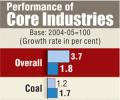
It hit more than a year's low of 1.8 per cent.

Indian economy is poised to do better on the back of reforms undertaken by the government and is expected to clock a 6.5-7 per cent growth in the remaining part of the decade, Chief Economic Advisor (CEA) V Anantha Nageswaran said on Tuesday. Addressing reporters here after the tabling of the Economic Survey in Parliament by Finance Minister Nirmala Sitharaman, Nageswaran said that by and large, inflation is likely to be "well behaved" in FY2023-24 barring headwinds. "My optimism is that in the coming decade, rest of the decade, the potential GDP growth, without taking into account export potential, because global economy is still rife with uncertainty, the growth rate would be around 6.5 to 7 per cent, rather than between 6 per cent and 6.5 per cent," he said.
RBI governor Das flags growth slowdown, deputy raises alarm on inflation

Bank credit growth declined to 8.5 per cent in January from 13.5 per cent in the year-ago period.
The EIU said in a report on Wednesday forecast that the real GDP grew by 1.6 per cent quarter-on-quarter in India, but noted that this uptick was largely owing to base effect.

Morgan Stanley believes that the factors responsible for the weak GDP growth include poor agricultural growth, weak investment trend, sluggish domestic market growth outlook and weakness in the service sector.
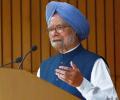
He said the 'toxic combination of deep distrust, pervasive fear and a sense of hopelessness in our society' is stifling economic activity and growth.

According to the 2013 International outlook by Columbia Management and Threadneedle Asset Management, its global partner, pace of growth in emerging markets have witnessed a slowdown over the last year, but still about 70 per cent of the world's incremental growth comes from these markets.

This is despite the fact that total FDI into India has fallen by 22 per cent from $58 billion in FY22 to $46 billion in FY23, according to the Reserve Bank of India.

A slowdown in India's growth rate, the bank said, has also affected the growth rate of South Asia. As a result, South Asia has fallen to second place after East Asia and the Pacific.

'The success of one or two IPOs does not dictate whether the upcoming IPOs will be successful or not, but it certainly indicates that the markets and investors are enthusiastic about startup IPOs.'
However, the World Bank has projected India's GDP growth rate at 7.5 per cent for the next three financial years, including the current one.

India's manufacturing sector witnessed a slowdown in July - the weakest growth rate since November - because of moderation in domestic and export orders amid sagging global economy, an HSBC survey said.

The Monetary Policy Committee (MPC) is expected to maintain the status quo on policy rates for the fourth consecutive time in its October 4-6 review meeting. The incremental information available since its last meeting in August suggests that growth and inflation prints for the second quarter (Q2) of financial year 2023-24 (FY24) will exceed the committee's projections. However, the Consumer Price Index (CPI)-based inflation is expected to moderate in the second half (H2) of FY24.

Economic growth has slipped to a six-year low of 5 per cent for the June quarter and is expected to turn in lower than that in the September quarter. Lack of consumption is seen as one of the key factors pulling down growth.

India's services sector activity eased in August but growth rates for new orders remain elevated, as services firms indicated the sharpest upturn in new export business which acted as a catalyst for firms to expand their workforces as well as output, a monthly survey said on Tuesday. Despite falling from 62.3 in July to 60.1 in August, the seasonally adjusted S&P Global India Services PMI Business Activity Index indicated one of the strongest increases in output seen since mid-2010. For the 25th straight month, the headline figure was above the neutral 50 threshold.

The number of ultra rich falls to 2.56 lakh in 2018 from 2.63 lakh. As much as Rs 262 lakh crore of the wealth possessed by the high networth individuals are in the form of financial assets, while the rest are parked in physical assets.

Mutual funds (MFs) are betting on a turnaround in the healthcare sector to boost returns but are divided on the prospects of the information technology (IT) sector amid uncertain growth outlook. At the end of June, all of the top 20 fund houses were overweight on the healthcare sector vis--vis the sector's presence in the BSE 200 index, shows a report by Motilal Oswal Financial Services (MOFS). In the case of the IT sector, only six of the 20 fund houses had overweight positions.

FPIs sold shares worth a net Rs 1236.95 crore on Friday.

According to data compiled by media research agency TAM, the rate of growth of advertising on television in terms of the number of hours was half during the January-June period this year in comparison with the corresponding period last year.

Nearly all FMCG companies like Marico, HUL, ITC and the rest have been indicating that the operating environment has been challenging, with drop in consumption, especially in rural areas, severe crunch in market liquidity conditions, and disruptions and floods in several parts of the country. To overcome this, they are boosting their direct reach in the countryside.
A recession is a decline in a country's gross domestic product (GDP) growth for two or more consecutive quarters of a year. A recession is also preceded by several quarters of slowing down.

Growth in FY14 is expected to be around 15 per cent, down from 19 per cent last fiscal.

Existing optimism about the capital goods sector has been enhanced by the Assembly election results, which were favourable for the BJP. The prospects of political continuity led to renewed interest in the sector. There are demand-supply gaps, especially in power, and visibility of improved pricing and strong order flows, including from private enterprises.

A major reason for the high growth in advertising spends as these companies are keen on higher volume
